

Introduction
Have you ever wondered why a lightning bolt lights up the sky, or why your muscles twitch when you exercise? The answer often comes down to one tiny but powerful word: ion. If you have ever asked yourself what does ion mean, you are not alone. It sounds like a term from a science fiction movie, but it is actually something you deal with every single day, whether you realize it or not.
In this article, we will break down what an ion actually is, in plain and simple language. We will look at what ion means in chemistry, what it means in biology, and the different types of ions you might come across. By the end, this confusing science word will feel a lot less intimidating and a lot more familiar.
What Does Ion Mean? A Simple Definition
Let’s start with the basics. An ion is an atom or molecule that has an electric charge because it has gained or lost one or more electrons. source: Merriam-Webster
Think of an atom like a tiny solar system. At the center is a nucleus, and tiny particles called electrons orbit around it. Normally, an atom has an equal number of positive particles (protons) and negative particles (electrons), so it stays neutral, like a balanced scale. viewflare
But when that atom gains or loses an electron, the scale tips. It becomes charged. And once it is charged, it is no longer just an atom. It is now called an ion.
One Sentence Definition
An ion is simply an atom or group of atoms that carries an electric charge because it has more or fewer electrons than protons.
Ion Meaning in Chemistry
In chemistry class, ions show up everywhere, and honestly, they are one of the most important building blocks of how matter behaves.
Here is the step by step way it works.
- An atom starts out neutral, with equal protons and electrons.
- The atom either gives away an electron or grabs an extra one from somewhere else.
- This creates an imbalance between the positive and negative charges.
- The atom becomes an ion, either positively or negatively charged.
I remember learning this in high school chemistry and thinking it sounded complicated. But once I pictured it like a tug of war over electrons, it clicked instantly. Atoms are basically fighting to be stable, and sometimes that fight means stealing or losing an electron.
Why Ions Matter in Chemistry
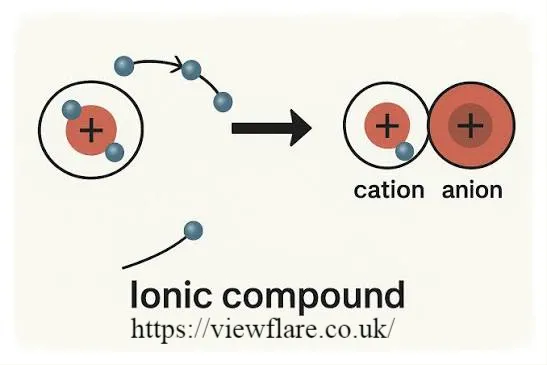
Ions are the reason table salt exists. Sodium loses an electron and becomes a positive ion. Chlorine gains that electron and becomes a negative ion. These two opposite charges attract each other, and boom, you get sodium chloride, which is just regular table salt.
This same idea explains many everyday chemical reactions, including: viewflare
- How batteries produce electricity
- How metals rust over time
- How acids and bases react with each other
- How water conducts electricity
Ion Meaning in Biology
Ions are not just a chemistry classroom topic. Your body depends on them every second of every day.
Inside your cells, ions like sodium, potassium, calcium, and chloride are constantly moving in and out. This movement creates tiny electrical signals that your nervous system uses to communicate.
Here is a simple breakdown of what ions do in your body.
- Sodium and potassium ions help your nerves send signals to your brain.
- Calcium ions help your muscles contract, which is how you move your arms and legs.
- Chloride ions help balance fluids inside and outside your cells.
Without these charged particles zipping around, your heart could not beat, your brain could not think, and your muscles could not move. That is a pretty big job for something so small.
A Real Life Example
Think about the moment you touch something hot and instantly pull your hand back. That reflex happens because sodium and potassium ions rush across your nerve cells at lightning speed, sending a warning signal to your brain and back down to your muscles. All of that happens in a fraction of a second, thanks to ions.
Types of Ions
Not all ions are the same. They generally fall into two main categories, based on their charge. VISIT…
Cations
A cation is an ion with a positive charge. This happens when an atom loses one or more electrons. Common examples include:
- Sodium (Na+)
- Potassium (K+)
- Calcium (Ca2+)
- Hydrogen (H+)
Anions
An anion is an ion with a negative charge. This happens when an atom gains one or more electrons. Common examples include:
- Chloride (Cl−)
- Fluoride (F−)
- Oxide (O2−)
There are also two other useful categories worth knowing.
- Monatomic ions, which are formed from a single atom, like sodium or chloride.
- Polyatomic ions, which are formed from a group of atoms bonded together, like sulfate or ammonium.
Real Life Examples of Ions
You interact with ions far more often than you might think. Here are a few places they show up in everyday life.
- Sports drinks contain electrolytes, which are just ions like sodium and potassium that help replace what you lose through sweat.
- Your smartphone and laptop batteries rely on lithium ions moving back and forth to store and release energy.
- Ocean water is salty because it is full of dissolved sodium and chloride ions.
- Static electricity, like the shock you feel touching a doorknob, happens because of a buildup of charged ions and electrons.
Once you start noticing them, you realize ions are quietly running the show in almost every area of science and daily life.
Common Questions People Ask About Ions
You might still have a few lingering questions, so let’s clear up some of the most common ones. VISIT…
Is an ion the same as an atom? Not exactly. An atom is neutral, while an ion is an atom or molecule that carries a charge because it gained or lost electrons.
Can a molecule be an ion? Yes. When a group of atoms bonded together carries an overall charge, it is called a polyatomic ion.
Are ions dangerous? Not on their own. Ions are a completely normal part of chemistry and biology, and your body actually needs them to function properly.
Conclusion
So, what does ion mean? At its core, an ion is simply an atom or molecule that carries an electric charge because it has gained or lost electrons. It might sound like a small detail, but ions play a massive role in chemistry, biology, and everyday life, from the salt on your fries to the signals firing in your brain right now as you read this.
Understanding ions helps you make sense of the world around you in a whole new way. Next time you sip a sports drink or charge your phone, you will know exactly what is happening behind the scenes.
Got questions about ions or another science topic that has been confusing you? Drop them in the comments, or share this article with someone who could use a clear, simple explanation.
FAQS
1. What does ion mean in simple terms?
An ion is an atom or molecule that has an electric charge because it gained or lost electrons.
2. What is the difference between a cation and an anion?
A cation has a positive charge because it lost electrons, while an anion has a negative charge because it gained electrons.
3. Why are ions important in the human body?
Ions like sodium, potassium, and calcium help your nerves send signals and your muscles move properly.
4. What is an example of an ion in everyday life?
Table salt is a great example, since it forms from sodium and chloride ions bonding together.
5. Are electrons the same as ions?
No. An electron is a tiny particle inside an atom, while an ion is an entire atom or molecule that has become charged.
also read: viewflare.co.uk
email: johanharwen@314gmail.com
Author Name: Alex Morgan
About the Author : Alex Morgan is a science writer who enjoys turning complicated topics into simple, everyday language. With a background in tutoring middle and high school students, Alex focuses on making science approachable for curious minds of all ages.