

Introduction
Have you ever looked at a water tank or a soda can and wondered how much it can actually hold? That question brings you straight to the volume of a cylinder. It sounds technical, but once you understand it, the math becomes simple and even fun.
Many students struggle with this topic because their textbooks make it sound complicated. You do not need to feel that way. In this article, you will learn what a cylinder is, what volume actually means, the formula you need, and how to use it correctly.
We will also walk through solved examples so you can practice the steps yourself. By the end, calculating the volume of a cylinder will feel like second nature. Let us break it down step by step.
Definition of Cylinder
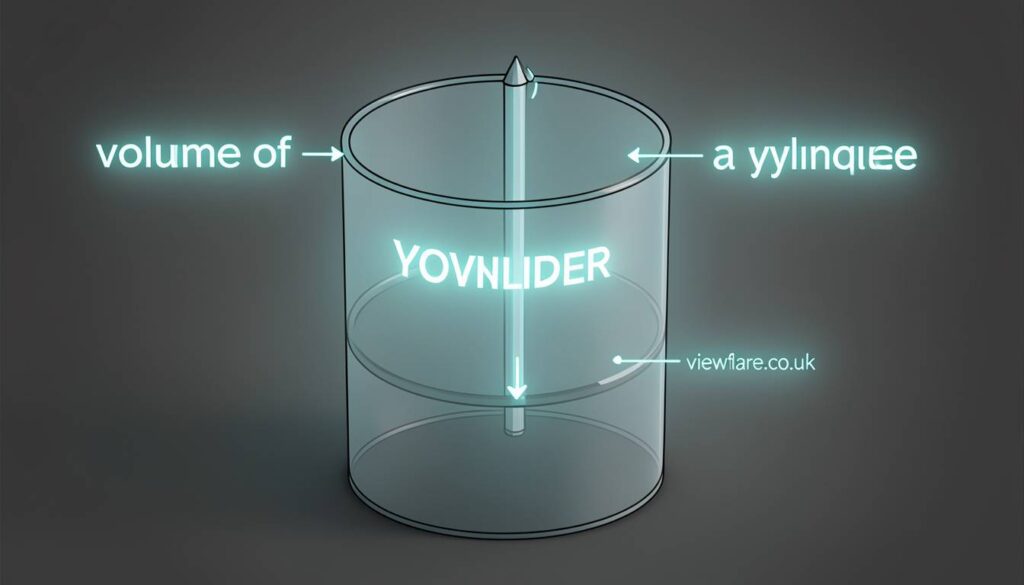
A cylinder is a three dimensional shape with two flat, circular ends and one curved surface connecting them. Think of a can of soup, a pipe, or a candle. All of these objects are cylinders because they share the same basic structure.
Every cylinder has two main measurements you need to know.
- Radius (r): The distance from the center of the circular base to its edge.
- Height (h): The distance between the two circular ends.
These two measurements are the building blocks for almost everything you calculate about a cylinder, including its volume. source: Omni Calculator
What Is Volume?
Volume tells you how much space an object takes up, or how much it can hold inside it. You measure volume in cubic units, such as cubic centimeters or cubic meters.
Imagine filling a cylindrical bottle with water. The amount of water that fits inside that bottle is its volume. The bigger the cylinder, the more space it has, and the more it can hold.
Volume matters in real life more than you might think. Engineers use it to design tanks. Chefs use it to measure ingredients. Even packaging companies use it to decide how much a container can hold. Understanding volume helps you make sense of the physical world around you.
Volume of a Cylinder Formula
Here is the formula you need to remember.
V = π × r² × h
In this formula:
- V stands for volume.
- π (pi) is a constant value, approximately 3.14159.
- r is the radius of the circular base.
- h is the height of the cylinder.
This formula works because a cylinder is essentially a stack of circles. The area of one circle is π × r². When you multiply that area by the height, you find out how much space the entire stack of circles fills. That space is your volume.
Why Does This Formula Work?
Picture a circular base with an area of π × r². Now imagine stretching that circle upward to create a three dimensional shape. Each layer of the cylinder has the same circular area. When you multiply the area by the height, you account for every single layer stacked on top of each other. That gives you the total volume.
How to Calculate Volume of a Cylinder
Calculating the volume of a cylinder becomes easy once you follow a clear process. Here are the steps you should follow every time.
- Identify the radius. If you are given the diameter instead, divide it by two to get the radius.
- Identify the height. Make sure both measurements use the same unit, such as centimeters or inches.
- Square the radius. Multiply the radius by itself.
- Multiply by pi. Use 3.14 or 3.14159 depending on how precise you need to be.
- Multiply by the height. This final step gives you the volume.
It helps to write each step down rather than trying to do it all in your head. I always tell students to slow down on step one, since using the diameter instead of the radius by mistake is the most common error people make.
Quick Tip
Always double check your units before you calculate. If your radius is in centimeters and your height is in meters, convert one of them first. Mixing units leads to wrong answers, even if your formula is correct.
Solved Examples
Let us put the formula into practice with a few examples.
Example 1: Basic Calculation
A cylinder has a radius of 4 cm and a height of 10 cm. Find its volume.
- V = π × r² × h
- V = 3.14 × 4² × 10
- V = 3.14 × 16 × 10
- V = 502.4 cm³
The cylinder has a volume of 502.4 cubic centimeters.
Example 2: Using Diameter
A water pipe has a diameter of 6 inches and a length of 20 inches. Find its volume.
First, find the radius. Since the diameter is 6 inches, the radius is 3 inches.
- V = π × r² × h
- V = 3.14 × 3² × 20
- V = 3.14 × 9 × 20
- V = 565.2 in³
The pipe holds 565.2 cubic inches of space.
Example 3: Real Life Example
A cylindrical water tank has a radius of 2 meters and a height of 5 meters. How many cubic meters of water can it hold?
- V = π × r² × h
- V = 3.14 × 2² × 5
- V = 3.14 × 4 × 5
- V = 62.8 m³
This tank can hold up to 62.8 cubic meters of water.
Common Mistakes to Avoid
Even simple formulas can lead to errors if you rush through the steps. Watch out for these common mistakes.
- Using the diameter instead of the radius without converting it first.
- Forgetting to square the radius before multiplying.
- Mixing different units of measurement within the same problem.
- Rounding pi too early, which can throw off your final answer.
Avoiding these small mistakes will make your calculations accurate every time.
Conclusion
Finding the volume of a cylinder does not need to feel overwhelming. Once you understand the definition of a cylinder, know what volume represents, and memorize the simple formula V equals pi times radius squared times height, the rest becomes a matter of practice.
Try solving a few problems on your own using everyday objects like a can or a bottle. Measure the radius and height, then calculate the volume yourself. It is a great way to see how math connects to the world around you.
Did this guide help clear up your confusion? Share it with a friend or classmate who might be struggling with the same topic, and feel free to bookmark it for quick revision before your next test.
Related searches people also ask:
- How do you find the volume of a cylinder
- What is the formula for volume of a cylinder
- How to calculate cylinder volume in liters
- Volume of a cylinder calculator
- Difference between volume and surface area of a cylinder
- How to find radius from diameter for volume
- Cylinder volume formula in real life
FAQs
1. What is the formula for the volume of a cylinder? The formula is V equals pi times radius squared times height, written as V = π × r² × h.
2. How do you find the volume of a cylinder if you only know the diameter? Divide the diameter by two to get the radius, then use the standard formula to calculate the volume.
3. What units are used for the volume of a cylinder? Volume is measured in cubic units, such as cubic centimeters, cubic meters, or cubic inches, depending on the units used for radius and height.
4. Is the volume of a cylinder the same as its capacity? Yes, in most practical cases, the volume of a cylinder represents how much liquid or material it can hold, which is its capacity.
5. What is the difference between volume and surface area of a cylinder? Volume measures the space inside the cylinder, while surface area measures the total area covering its outer surface, including the curved part and both circular ends.
6. Can you use 22 over 7 instead of 3.14 for pi? Yes, both values are common approximations of pi, and either one works fine for most calculations.
7. Why do we square the radius in the volume formula? Squaring the radius gives you the area of the circular base, which is then multiplied by the height to calculate the total volume.
8. How does the volume of a cylinder apply in real life? It applies in many areas, including designing water tanks, manufacturing cans, building pipes, and measuring storage containers.
also read: viewflare.co.uk
email: johanharwen@314gmail.com
Author Name: Sarah Mitchell
About the Author : Sarah Mitchell is a math educator and content writer with a passion for making geometry simple and approachable. She enjoys breaking down tricky formulas into clear, easy to follow steps that help students build confidence in math.