
Introduction
You have probably heard both terms thrown around a lot lately. AI is everywhere now, from your Netflix recommendations to ChatGPT helping you write emails. But then someone mentions AGI, and suddenly the conversation gets a lot more serious. What is the difference between AI and AGI, and why does it matter so much?
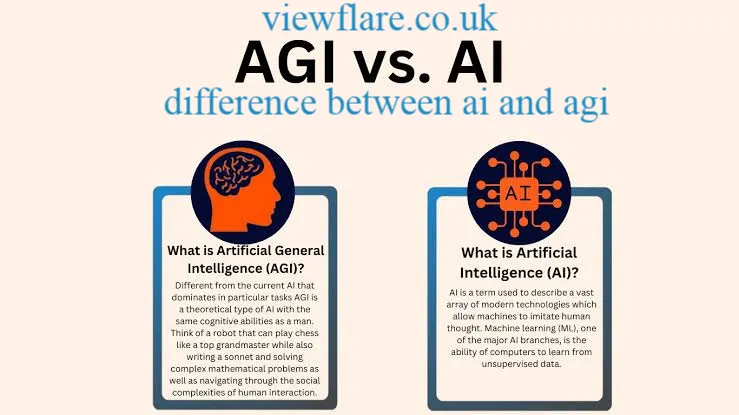
Here is the short answer: AI refers to machines that are trained to do specific tasks very well. AGI, or Artificial General Intelligence, refers to a machine that can think, learn, and reason across any task just like a human being can. One exists today. The other does not, at least not yet.
In this article, you will learn what each term actually means, how they compare, what misconceptions people hold, and why the gap between them is far bigger than most people realize.
What Is AI?
Artificial Intelligence is software that uses data and algorithms to perform specific tasks. It learns from patterns and makes predictions or decisions based on that training. AI systems like ChatGPT, image generators, and voice assistants are powerful within their defined scope, but they cannot operate meaningfully outside it. source: Forbes
What Is AGI?
Artificial General Intelligence is a theoretical form of machine intelligence that can understand, learn, and apply knowledge across a wide range of tasks, just like a human. AGI would not need retraining to switch from writing code to composing music. It would figure things out on its own, with full reasoning ability.
The Core Difference Between AI and AGI
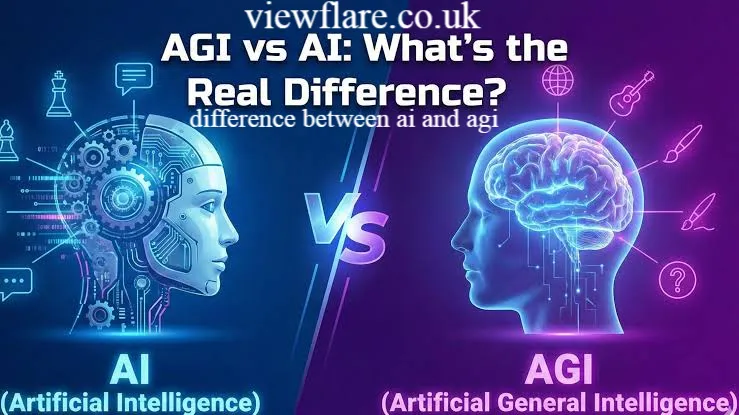
The difference between AI and AGI comes down to flexibility and understanding. Current AI is narrow. It does one thing well. AGI would do everything well, and more importantly, it would understand what it is doing.
Think of it this way. A chess AI can beat the world champion at chess. But it cannot explain the rules of chess to a child, bake a cake, or decide to take up painting. An AGI could do all of those things, and it would learn how on its own.
Key Differences: AI vs AGI
Here is a numbered breakdown of the most important differences:
- Scope of ability: AI handles specific tasks. AGI handles any intellectual task a human can.
- Learning style: AI learns from curated training data. AGI would learn continuously from experience.
- Adaptability: AI struggles outside its training domain. AGI would adapt instantly to new situations.
- Understanding: AI mimics understanding through pattern recognition. AGI would actually comprehend context and meaning.
- Autonomy: AI requires human design and oversight for each use case. AGI would operate independently across domains.
- Existence: AI exists and is widely deployed today. AGI does not yet exist in any verified form.
Comparison Table: AI vs AGI
| Feature | AI (Narrow AI) | AGI |
|---|---|---|
| Task range | Single or limited tasks | Any intellectual task |
| Learning | Pre-trained on fixed data | Continuous, self-directed learning |
| Flexibility | Low outside its domain | High across all domains |
| Emotional reasoning | None | Theoretical, yes |
| Current status | Exists and widely used | Does not yet exist |
| Examples | ChatGPT, DALL.E, Alexa | No real-world example yet |
| Self-awareness | None | Theoretically possible |
| Human-level reasoning | No | Yes, by definition |
Real-World Examples of AI Today
You interact with AI constantly, even when you do not realize it. Here are some familiar examples: viewflare
- ChatGPT answers questions, writes content, and summarizes documents. But it has no awareness of what it is doing.
- Image generators like Midjourney or DALL.E create visuals from text prompts. They cannot decide to learn photography next.
- Recommendation systems on YouTube or Spotify learn what you like. But they only optimize for one goal: engagement.
- Self-driving software navigates roads using sensors and training data. It cannot suddenly start diagnosing engine problems.
None of these are AGI. They are impressive, narrow tools built for specific outcomes.
Why Does This Difference Matter?
The difference between AI and AGI is not just academic. It has real implications for jobs, safety, and how we design future systems.
Current AI can automate repetitive tasks and accelerate research. That is already changing industries. AGI, if it ever arrives, would represent a fundamentally different kind of change. It could potentially outperform humans in every cognitive domain simultaneously.
Researchers at organizations like OpenAI, DeepMind, and Anthropic are working toward more general systems. But honest experts admit we are still far from true AGI. Some think it could arrive within decades. Others believe it may never arrive in the form we imagine.
Common Misconceptions to Clear Up
Many people confuse powerful AI with AGI. Here are some misconceptions worth addressing: source: Coursera
Misconception 1: ChatGPT is AGI.
It is not. ChatGPT is a large language model. It generates text based on patterns. It does not understand, feel, or reason the way humans do.
Misconception 2: AGI is just smarter AI.
Not exactly. AGI is not about being smarter. It is about being general. The difference is qualitative, not just quantitative.
Misconception 3: AGI already exists in secret.
There is no verified evidence of this. Researchers across the world would need enormous computing resources to build something like AGI, and it could not be hidden easily.
Misconception 4: AI will automatically become AGI over time.
This is false. Scaling up narrow AI does not automatically produce general intelligence. It produces better narrow AI.
Where Is AI Heading Right Now?
AI development is moving fast. In 2023 and 2024, we saw major leaps with models like GPT-4, Gemini Ultra, and Claude. These systems can handle multiple types of inputs, reason through problems, and generate human-level text. But they still operate within limits set by their training and design.
Researchers are exploring concepts like chain-of-thought reasoning, tool use, and multimodal processing. These push the boundaries of what AI can do. But none of these developments cross the line into AGI.
Conclusion
The difference between AI and AGI is one of the most important distinctions in tech today. AI is here, it is real, and it is already reshaping how we work and live. AGI is still theoretical, still debated, and possibly decades away.
Understanding this difference helps you cut through the hype and make sense of what you actually see in the world around you. Next time someone tells you that a chatbot has become sentient or that AGI is already here, you will know better.
What do you think: will AGI ever truly arrive, or is human-level machine intelligence always going to be just out of reach? Share your thoughts with someone who loves this topic.
FAQs
1. What is the main difference between AI and AGI?
AI handles specific tasks it is trained for. AGI would handle any intellectual task independently, just like a human.
2. Does AGI exist today?
No. AGI does not currently exist. All AI systems today are narrow AI, built for specific purposes.
3. Is ChatGPT an example of AGI?
No. ChatGPT is a narrow AI language model. It generates text based on patterns but does not truly understand or reason.
4. How close are we to AGI?
Estimates vary widely. Some researchers say decades away. Others are more skeptical and believe it may not be achievable with current approaches.
5. Why is AGI considered dangerous?
A system with human-level or beyond-human intelligence operating independently could pose risks if its goals are misaligned with human values. This is why AI safety research matters.
6. Can AI become AGI on its own?
No. Scaling up a narrow AI does not automatically produce general intelligence. AGI requires fundamentally different architectures and approaches.
7. What companies are working on AGI?
OpenAI, DeepMind, Anthropic, and Google are all conducting research toward more general AI systems, though none have achieved AGI.
8. Is AGI the same as superintelligence?
Not exactly. AGI matches human-level intelligence across all domains. Superintelligence goes beyond that, surpassing human ability in every area.
9. Will AGI replace all human jobs?
AGI is theoretical. Current AI automates specific tasks. Whether AGI would replace jobs entirely is still a subject of ongoing debate and speculation.
10. How is AGI different from a robot?
Robots are physical machines, often with AI inside them. AGI refers to the intelligence itself, which could run on any hardware, physical or digital.
Author Bio: Sara Mitchell is a technology writer with over seven years of experience covering AI, machine learning, and emerging tech trends. She simplifies complex topics for everyday readers and contributes to several digital publications focused on the future of technology.
email: johanharwen@314gmail.com
Author Name: Sara Mitchell