Margaret Hamilton NASA: The Engineer Who Kept Apollo 11’s Computer Alive

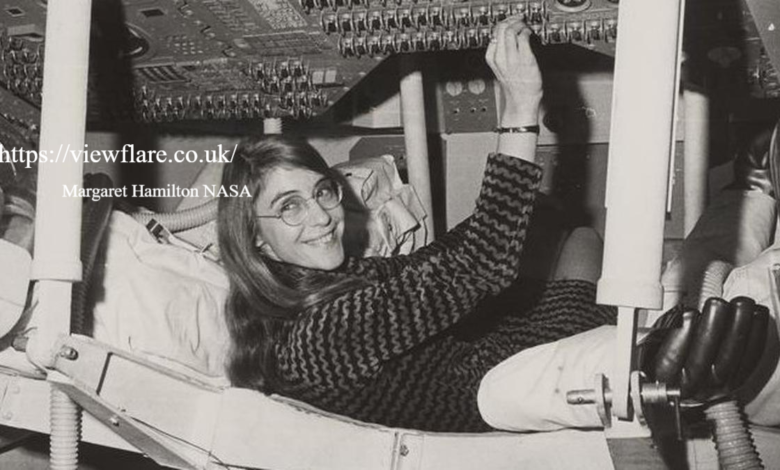
On July 20, 1969, Neil Armstrong and Buzz Aldrin were minutes from landing on the Moon when the lunar module’s computer began flashing alarms. Margaret Hamilton NASA The landing continued, and the software behind that moment is why Margaret Hamilton’s name is tied to the Apollo program. Her story is more interesting than the legend, because the legend gives her too much credit for some things and too little for others.
Who Was Margaret Hamilton?
Margaret Hamilton is an American computer scientist and systems engineer who led the team that developed onboard flight software for NASA’s Apollo missions. She was born Margaret Heafield on August 17, 1936, in Paoli, Indiana, and earned a mathematics degree in 1958.
She had planned to pursue graduate study in abstract mathematics. Instead she took a programming job at MIT, working first on weather prediction software and then on defense projects. At the time, almost no one had formal training in the field. People simply learned by doing.
She later became director of the Software Engineering Division at the MIT Instrumentation Laboratory (later renamed Draper Laboratory), which developed on-board flight software for NASA’s Apollo program. google
What Did Margaret Hamilton Do for NASA?
She led the MIT team that wrote and tested the in-flight software for the Apollo Command Module and Lunar Module. She was the first programmer hired for the Apollo project at MIT and was responsible for the team writing and testing all onboard flight software for the spacecraft. awis
Her own focus was on a problem that sounds obvious now but was radical then: what happens when something goes wrong? She concentrated on software to detect system errors and to recover information in a computer crash. awis
Technically, she was an MIT employee working on a NASA contract, not a NASA staff member. That is why the most precise phrasing is “MIT’s lead Apollo software engineer working for NASA’s program.” Source:mit.edu
The Apollo Guidance Computer: Why the Software Was So Hard
The Apollo Guidance Computer (AGC) was a landmark machine, but its limits were severe. It had roughly 2,000 words of erasable memory and about 36,000 words of fixed memory, which was physically woven into “core rope” wire. For comparison, a modern phone holds millions of times more.
Within that space the software had to handle navigation, guidance, engine control and astronaut displays, all in real time. A bug could not be patched after launch. This is the definition of mission-critical software, and it forced the team to treat reliability as a design requirement from the start.
How Did Margaret Hamilton Help Apollo 11 Land?
Her team’s priority-driven error handling let the computer keep working through an overload, so the landing could continue.
During descent, the computer displayed 1201 and 1202 program alarms. The cause was extra processing load from the rendezvous radar, which was active when it did not need to be. The AGC was being asked to do more than it could finish.
Because of how the software was designed, the computer did not freeze. It shed lower-priority tasks, restarted what it needed and kept running the critical landing work. Mission Control, advised by controllers such as Steve Bales and Jack Garman, judged the alarms safe to continue through, and the lunar module Eagle touched down in the Sea of Tranquility.
The asynchronous scheduling approach used on Apollo drew on the earlier work of MIT’s Halcombe Laning. Hamilton’s team built and refined the surrounding error detection and recovery logic, and tested it relentlessly. The software did what it was designed to do under pressure.
The Story Behind the “Impossible Error” Idea
One well-known anecdote involves Hamilton’s young daughter, Lauren, who visited the lab and played with a simulator, accidentally triggering a crash by running a preflight program mid-flight. Hamilton wanted protective checks added. Managers reportedly believed trained astronauts would never make that mistake.
Later, during Apollo 8, astronaut Jim Lovell accidentally caused a similar problem in flight, wiping navigation data, and it had to be fixed using a workaround. Hamilton has repeatedly cited such episodes as proof that software must anticipate human error rather than assume perfection. This account comes largely from Hamilton’s own retelling over the years, so treat the details as her recollection rather than official NASA record.
Did Margaret Hamilton Write the Apollo 11 Software Herself?
No. She led the team, and Apollo software was written by many engineers.
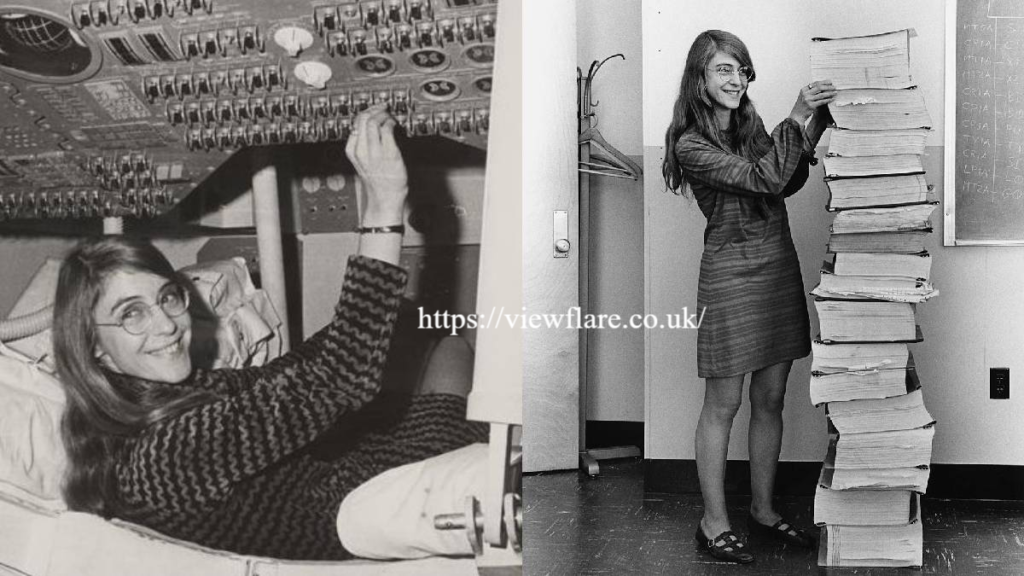
This is the most common misunderstanding. The famous 1969 photo shows her standing beside a tall stack of printed code listings. It is often described as “the code she wrote.” In reality it represents the work of the whole MIT software group, spanning both the Command Module and Lunar Module programs.
Her genuine contributions were leadership, engineering discipline and a philosophy of designing for failure. That is arguably a bigger legacy than writing any single routine, and it doesn’t need exaggeration.

Why Is Margaret Hamilton Considered a Software Engineering Pioneer?
She helped establish software as a rigorous engineering discipline at a time when many treated it as an afterthought. She is one of the people credited with coining the term “software engineering.” By her account, she used the phrase to give programming the same seriousness as hardware engineering. google
Several ideas from her era remain central today:
- Design for failure: assume inputs will be wrong and components will break.
- Prioritization: let critical tasks override less important ones.
- Testing under stress: simulate bad conditions, not just ideal ones.
- Treating software as a system: consider hardware, humans and software together.
Her Career After Apollo
She left MIT in the mid-1970s. She cofounded Higher Order Software in 1976 and founded Hamilton Technologies a decade later. Her later research focused on building systems correctly by construction, an approach she called “development before the fact,” which underpins her Universal Systems Language. According to biographical sources, she has published more than 130 papers, proceedings and reports. britannicagoogle
Margaret Hamilton’s Awards and Recognition
| Year | Honor |
|---|---|
| 2003 | NASA Exceptional Space Act Award for her Apollo contributions |
| 2016 | Presidential Medal of Freedom, presented by President Barack Obama on November 22 |
NASA awarded the Exceptional Space Act Award in 2003 to honor her contribution to the success of the Apollo missions. On November 22, 2016, she received the Presidential Medal of Freedom for her work leading to the development of on-board flight software. britannicagoogle
Margaret Hamilton’s Legacy for Modern Software
Today’s aircraft systems, medical devices, banking platforms and autonomous vehicles all rely on the same principle her team put into practice: software must stay safe when conditions go wrong. Her story is also a landmark chapter in the history of women in computing, showing that foundational technical leadership came from people history often overlooked.
For students, her career is a reminder that important fields are sometimes built before they have a name or a curriculum.

6. Custom FAQ Section
Is there a Margaret Hamilton NASA movie?
There is no major feature film about her life that I could find. She appears in documentaries and space-history programming, especially around Apollo anniversaries. Don’t confuse her with Hamilton, the Broadway musical about Alexander Hamilton, which is unrelated.
Does Margaret Hamilton from NASA have kids?
Yes. She has a daughter, Lauren, who appears in the well-known story about the simulator error that inspired Hamilton’s push for error protection.
Where can I see Margaret Hamilton’s NASA code?
Apollo flight software has been digitized and made publicly available through projects such as Virtual AGC, and copies of the Command Module and Lunar Module code are hosted on GitHub. It is written in AGC assembly language and credits an entire MIT team, not one person.
What is Margaret Hamilton’s NASA net worth?
There is no reliable public figure, so any number you see is speculation. What is documented is her professional record: two software companies and major honors such as the 2003 NASA Exceptional Space Act Award.
What is the latest on Margaret Hamilton and NASA in 2026?
She turned 90 on August 17, 2026. As of October 2026, I found no credible reports of her death or of a new NASA role. Apollo anniversaries and women-in-STEM features continue to cite her work, and you should check recent news before publishing any update.
How tall is Margaret Hamilton?
Her height is not publicly documented. The famous 1969 photo shows her beside code printouts, and the claim that the stack is as tall as she is has circulated widely, but that comparison is not a measurement.
What is Margaret Hamilton’s IQ?
No credible, verified IQ score exists, and she has never publicly released one. Her record of work speaks for itself.
Is Margaret Hamilton from NASA still alive?
Based on the sources I could find, yes. Born August 17, 1936, she would be 90, and I found no credible reports of her death. Claims that she “died at 90” appear to be unsupported.