
What Is Quantum Computing: The Brilliant Technology Changing Everything in 2026

Introduction
Your laptop solves problems by processing information as zeros and ones. It works beautifully for most everyday tasks. But some problems are so complex that even the fastest supercomputer on Earth would take millions of years to solve them. Quantum computing exists to solve exactly those problems.
Understanding what is quantum computing has become essential knowledge for anyone working in technology, science, medicine, finance, or cybersecurity. This technology is no longer science fiction. It is already reshaping industries and attracting billions in investment from governments and corporations worldwide.
This article explains what is quantum computing in genuinely simple terms. You will learn the core principles, how it differs from classical computing, what it can actually do today, which companies lead the field, and what the future holds. Whether you are a complete beginner or someone looking to deepen your understanding, every concept here is explained clearly with practical analogies and real-world examples.
Quick Answer: What Is Quantum Computing?
Quantum computing is a type of computation that uses quantum mechanical phenomena such as superposition and entanglement to process information in fundamentally different ways than classical computers, enabling them to solve certain complex problems exponentially faster.
In simpler terms: a classical computer thinks in black and white. A quantum computer thinks in every color simultaneously. viewflare
What Is Quantum Computing? The Full Explanation
Classical Computing vs Quantum Computing
Every device you use today runs on classical computing. Classical computers process information as bits. Each bit holds one value: either 0 or 1. This binary system handles most tasks brilliantly. But certain problems require exploring enormous numbers of possibilities simultaneously. Classical computers do this sequentially, one possibility at a time. This takes an impractically long time for highly complex problems.
Quantum computing replaces classical bits with qubits. A qubit can represent 0, 1, or both simultaneously through a quantum property called superposition. This single difference creates computational power that scales exponentially with each additional qubit added to the system. viewflare
Quantum vs Classical Computing: Side by Side Comparison
| Feature | Classical Computing | Quantum Computing |
|---|---|---|
| Basic Unit | Bit (0 or 1) | Qubit (0, 1, or both) |
| Processing Style | Sequential | Parallel and simultaneous |
| Problem Scale | Handles everyday complexity | Handles extreme complexity |
| Current Maturity | Fully mature and widespread | Early commercial stage |
| Error Rate | Very low | Currently high (being reduced) |
| Best Use Cases | General purpose computing | Optimization, simulation, cryptography |
| Leading Companies | Intel, AMD, Apple | IBM, Google, IonQ, D-Wave |
| Temperature Required | Room temperature | Near absolute zero for most systems |
| Physical Size | Desktop to data center | Currently laboratory-scale |
| Cost | Accessible to individuals | Millions of dollars per system |
The Three Core Principles of Quantum Computing
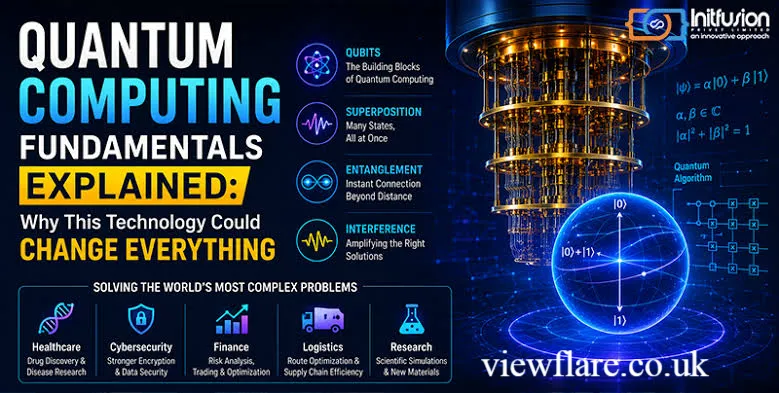
Superposition
Think of a classical bit as a coin lying flat on a table. It is either heads or tails. A qubit in superposition is like a coin spinning in the air. While spinning, it is both heads and tails simultaneously. Only when you measure it does it land on one definitive state.
This property allows quantum computers to explore multiple solution paths at the same time. A system with 300 qubits in superposition can represent more states simultaneously than there are atoms in the observable universe.
Entanglement
Entanglement is a quantum property where two or more qubits become linked regardless of the physical distance between them. When you measure the state of one entangled qubit, you instantly know the state of its partner. Albert Einstein famously called this “spooky action at a distance.”
In quantum computing, entanglement allows qubits to work together in highly coordinated ways. This dramatically increases the computational power available for complex problem-solving tasks that require many variables to be considered simultaneously.
Quantum Interference
Quantum interference is the technique quantum algorithms use to amplify correct answers and cancel out incorrect ones. Think of it like noise-canceling headphones. The headphones identify unwanted sound waves and generate opposing waves to eliminate them. Quantum algorithms use interference to suppress wrong computational paths and strengthen the path toward the correct solution.
These three principles work together to create computational capabilities that have no equivalent in classical systems.
Beginner to Advanced: What Can Quantum Computing Actually Do?
Beginner Level: What Problems Does It Solve?
Quantum computing excels at specific problem types that are genuinely impractical for classical computers:
- Optimization problems: Finding the most efficient delivery route across millions of options
- Molecular simulation: Modeling exactly how drug molecules interact with human cells
- Cryptography: Breaking or creating encryption systems far beyond current capabilities
- Machine learning: Training complex AI models dramatically faster than classical hardware
- Financial modeling: Running risk analysis across thousands of market scenarios simultaneously
Intermediate Level: How Quantum Algorithms Work
Quantum algorithms are specially designed programs that exploit superposition and interference. The most famous examples include: source:
- Shor’s Algorithm: Factors large numbers exponentially faster than any classical method. This threatens current RSA encryption systems used to protect internet communications worldwide.
- Grover’s Algorithm: Searches unsorted databases quadratically faster than classical search methods.
- Quantum Approximate Optimization Algorithm (QAOA): Tackles complex optimization problems in logistics, energy, and finance.
These algorithms only run effectively on quantum hardware. Running them on classical computers eliminates their advantage entirely.
Advanced Level: Quantum Error Correction
The biggest current limitation of quantum computing is qubit fragility. Qubits lose their quantum state through a process called decoherence. Environmental interference from heat, vibration, or electromagnetic noise causes qubits to collapse from their quantum state into classical states prematurely.
Quantum error correction addresses this by encoding logical qubits across many physical qubits. This redundancy allows the system to detect and correct errors without measuring the qubit directly. IBM, Google, and Microsoft are actively competing to achieve fault-tolerant quantum computing, the milestone where error correction fully stabilizes quantum operations at scale.
Real-World Use Cases and Current Applications
Quantum computing is not purely theoretical. Real applications are already emerging across multiple industries. viewflare
Healthcare and Drug Discovery: Pharmaceutical companies use quantum simulation to model protein folding and molecular interactions at a level of precision impossible for classical computers. This accelerates drug discovery timelines from decades to potentially years.
Financial Services: Investment banks use quantum optimization to manage portfolio risk, detect fraud patterns, and optimize trading strategies across enormous datasets simultaneously.
Climate and Energy: Quantum computing helps model complex climate systems and optimize energy grid management. It also accelerates research into new battery technologies and renewable energy materials.
Logistics and Supply Chain: Shipping companies use quantum optimization to calculate the most efficient routes for thousands of vehicles simultaneously, reducing fuel costs and delivery times.
Cybersecurity: Governments and security agencies are developing quantum-resistant encryption protocols to protect sensitive communications before powerful quantum computers make current encryption systems obsolete.
Leading Companies and Research Organizations
The quantum computing landscape includes both established technology giants and specialized startups.
IBM leads with its IBM Quantum platform, offering cloud access to quantum processors. IBM has consistently expanded qubit counts and announced roadmaps targeting fault-tolerant systems within this decade.
Google made history in 2019 claiming quantum supremacy when its 53-qubit Sycamore processor completed a calculation in 200 seconds that IBM estimated would take classical supercomputers 10,000 years.
IonQ uses trapped ion technology offering more stable qubits with lower error rates than competing superconducting approaches.
D-Wave focuses on quantum annealing, a specialized approach suited for optimization problems, already deployed commercially by companies including Volkswagen and Lockheed Martin.
Microsoft is pursuing a different path using topological qubits, which are theoretically more stable and less error-prone than current qubit designs.
Research Organizations including MIT, Caltech, and the European Quantum Flagship initiative are advancing fundamental quantum science that underpins all commercial development.
What Is Quantum Computing Today vs The Future?
Today, quantum computers operate in what researchers call the Noisy Intermediate-Scale Quantum (NISQ) era. Current systems have limited qubit counts and significant error rates. They demonstrate quantum advantage only on specific narrow problems. source: IBM
The future brings fault-tolerant quantum computers with millions of stable logical qubits. At that scale, quantum computing solves the hardest optimization, simulation, and cryptographic problems without practical time limits. Industry analysts at McKinsey estimate quantum computing could generate 450 to 850 billion dollars in value annually by 2040 across pharmaceutical, chemical, automotive, and financial sectors.
Conclusion
What is quantum computing? It is the next fundamental leap in how humanity processes information. Built on superposition, entanglement, and interference, quantum computers tackle complexity that classical systems simply cannot handle within practical time frames.
The technology is real, growing rapidly, and already producing early commercial applications across healthcare, finance, logistics, and cybersecurity. IBM, Google, IonQ, D-Wave, and Microsoft are all racing to reach fault-tolerant quantum computing within this decade. The timeline is accelerating faster than most outside the field realize.
What aspect of quantum computing interests you most? The scientific principles, the real-world applications, or the security implications for today’s encrypted internet? Share your thoughts in the comments and let us explore this fascinating topic further together.
FAQs
1. What is quantum computing in simple terms? Quantum computing uses quantum mechanics to process information using qubits that can represent 0, 1, or both simultaneously. This allows quantum computers to explore many solutions at once, making them exponentially faster than classical computers for specific complex problems.
2. How is quantum computing different from classical computing? Classical computers process bits as either 0 or 1. Quantum computers use qubits that exist in superposition, representing multiple states simultaneously. This fundamental difference enables quantum computers to solve certain optimization, simulation, and cryptographic problems that would take classical computers millions of years.
3. What is a qubit? A qubit is the quantum equivalent of a classical bit. Unlike a bit that holds either 0 or 1, a qubit uses superposition to hold 0, 1, or both simultaneously until measured. Multiple entangled qubits working together create exponentially greater computational power.
4. Is quantum computing available to the public? Yes, in limited form. IBM and Google both offer cloud-based access to real quantum processors through their quantum cloud platforms. Researchers, developers, and students can write and run quantum programs on real quantum hardware remotely.
5. What is quantum supremacy? Quantum supremacy refers to the point where a quantum computer completes a specific calculation faster than the most powerful classical supercomputer could. Google claimed this milestone in 2019 with its Sycamore processor, though the claim remains debated in the scientific community.
6. Will quantum computers replace classical computers? No. Quantum computers excel at specific problem types but are impractical for everyday computing tasks. Classical computers handle general computing far more efficiently. The future involves both technologies working together, with quantum systems handling specialized high-complexity tasks.
7. Why do quantum computers need to be so cold? Most quantum computers use superconducting qubits that must operate near absolute zero (approximately minus 273 degrees Celsius) to maintain quantum coherence. Even tiny amounts of heat cause decoherence, disrupting quantum states and introducing errors.
8. What is quantum entanglement in computing? In quantum computing, entanglement links two or more qubits so that measuring one instantly reveals the state of its partner regardless of distance. This coordination allows quantum processors to perform complex parallel computations that classical architectures cannot replicate.
9. What are the biggest challenges in quantum computing today? The main challenges are qubit fragility and high error rates caused by decoherence, limited qubit counts in current systems, difficulty scaling hardware while maintaining performance, and developing practical quantum algorithms that deliver real advantages over classical approaches.
10. When will quantum computing become mainstream? Most experts predict fault-tolerant quantum computing with practical commercial scale arriving between 2030 and 2040. Early specialized applications are already commercial today. The pace of progress is accelerating, with major milestones announced by IBM, Google, and others on increasingly ambitious timelines.
About the Author : Dr. James Elliot is a technology writer and science communicator with a background in computational physics and over twelve years of experience translating complex scientific and technological concepts into clear, accessible language. He has covered quantum computing, artificial intelligence, and emerging technologies for leading science publications and corporate research teams. James believes that understanding transformative technologies should not require a PhD. When he is not writing, he lectures on emerging technology trends at universities and innovation conferences worldwide.
email: johanharwen@314gmail.com
Author Name: Dr. James Elliot